Formats
Under eye patches: do they work, how to use them and how hydrogel eye patches are made
Do under eye patches work? How hydrogel eye patches are made, how to use them for puffy eyes and dark circles, and how brands launch their own line.

Under eye patches are small, crescent-shaped pads, usually made of hydrogel, that are pre-loaded with serum and placed under the eyes for 10 to 20 minutes. They help the under-eye area feel hydrated and look smoother and less puffy for a few hours. This guide answers whether eye patches work, how to use them, and how a brand can launch its own hydrogel eye patches.
What are under eye patches?
Under eye patches are single-use pads that hold a concentrated serum against the skin below the eyes. Shoppers also call them eye patches, eye pads, eye gels or eye mask patches.
The patch itself acts as a light occlusive layer, so the serum stays on the skin instead of evaporating. Most patches are sold in pairs, either in a jar of 30 pairs with a small spatula or in single sachets. Some are designed as larger masks that cover the whole eye area or the smile lines as well.
Eye patches sit between cleansing and eye cream in a routine, and they appeal to a wide audience: eye patches for women remain the core market, but patches marketed simply as eye patches for adults, or for men, broaden the reach. Salons and spas use them during facials, so the client relaxes with patches on while another step works. That flexibility is one reason patches are often the first eye product a new brand launches.
Do under eye patches work?
Yes, for a quick, temporary refresh: they hydrate the skin surface and help reduce the look of puffiness. They do not change the structure of the eye area.
Three things make them work. The gel holds water-binding ingredients such as hyaluronic acid against the skin. The cooling feel, especially from a chilled patch, helps the area look less puffy. And caffeine or green tea adds a depuffing ingredient. The effect lasts hours, not weeks, which is why patches are bought for mornings, events and self-care moments.
The honest limits are the same as for any eye product: patches cannot remove fat-pad eye bags, fill hollows or change inherited pigmentation. Our guide to eye cream for dark circles and puffiness explains these causes in more detail.
Hydrogel, sheet, microneedle or silicone: which eye patches?
Hydrogel eye patches are the most popular, but four materials are on the market, each with a different feel and use.
| Type | What it is | Feel | Typical use |
|---|---|---|---|
| Hydrogel eye patches | Jelly-like polymer gel holding serum inside | Cool, clingy, no drips | Daily refresh, puffy eyes, gifting |
| Sheet eye patches | Fiber or fabric cut-out soaked in essence | Wet, light | Sampling in sets, travel |
| Microneedle patches | Patch with tiny dissolving cones of hyaluronic acid | Slight prickle, overnight wear | Fine lines and creases, premium lines |
| Reusable silicone patches | Washable silicone pad with no serum | Smooth, occlusive | Worn over the customer’s own eye cream |
Mars lists hydrogel eye patches in its catalogue, including Green Tea & Caffeine Hydrogel Eye Patches for puffy eyes and Hyaluronic & Ceramide Hydrogel Eye Patches for dry under-eye skin. Reusable silicone patches are not part of the catalogue, but they can be discussed as an ODM accessory.
How to use under eye patches
Apply eye patches to clean, dry skin, leave them on for 10 to 20 minutes, then remove them and pat in the remaining serum.
- Chill the jar in the fridge for a stronger cooling effect, if the pack allows it.
- Cleanse and pat the skin dry, so the gel can cling properly.
- Lift the patch with the spatula, not fingers, to keep the jar hygienic.
- Place it just below the lower lash line, wide end towards the outer corner, keeping clear of the eye itself.
- Wait 10 to 20 minutes, then peel off from the outer edge.
- Pat in the leftover serum and follow with eye cream and sunscreen in the morning.
The same steps apply to an eye gel mask that covers the whole eye area.
Are eye patches good for dark circles and puffy eyes?
Eye patches for puffy eyes are effective in the cosmetic sense; for dark circles, they help mainly by hydrating thin skin so shadows look softer. They are not a dark circle treatment.
For puffiness, caffeine and green tea patches stored in the fridge are the strongest choice. For dark circles, look for patches that combine hydration with a brightening ingredient such as niacinamide or a vitamin C derivative, and set realistic expectations in the copy: “brighter-looking” and “refreshed”, not “erased”. Patches for bags under the eyes should be described the same way.
Do collagen eye patches work?
Collagen eye patches hydrate and smooth the skin surface, but the collagen in them does not replace the skin’s own collagen. The molecule is too large to travel deep into the skin.
Hydrolyzed collagen acts as a humectant and film-former: it holds moisture on the surface and leaves skin feeling soft, which helps fine lines look less visible for a while. That is a real benefit, and it is the accurate way to describe eye patches for wrinkles and collagen-themed patches.
Beyond the eyes: hydrogel face masks
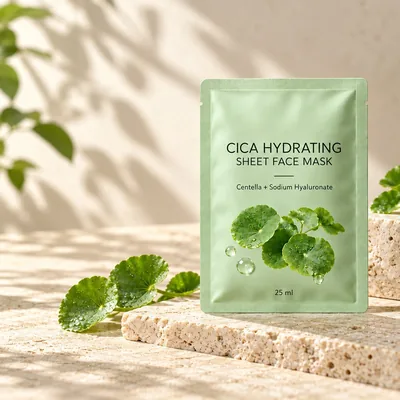
The same hydrogel technology is used for full-face masks, which are a natural partner product for an eye patch line. A hydrogel face mask or hydrogel sheet mask clings to the face, stays cool and holds serum without dripping.
Mars offers the Centella Barrier Hydrogel Face Mask and a Vacuum-Sealed Hydrogel Face Patch in its masks and patches range. Pairing a face mask with eye patches makes an easy self-care bundle. Our article on sheet masks and hydrogel face masks compares the formats.
How to package custom eye patches
Custom eye patches are usually packed in one of three ways, and the choice shapes the product’s positioning.
- Jar of pairs with spatula: the retail standard; shows the patches through a clear or tinted jar and gives a month of use.
- Single-pair sachets: hygienic, ideal for salons, spas, hotels, travel kits and subscription boxes.
- Boxed sachets: a carton of five or ten sachets for gifting and pharmacies.
Patch shape, gel color and the serum’s scent can also be adjusted to fit a brand’s identity.
Storage advice belongs on the pack too. Hydrogel holds a lot of water, so jars should be closed tightly after each use and kept away from heat and direct sun. Many customers like to keep them in the fridge, which also strengthens the cooling feel. Clear directions on the label reduce complaints about patches drying out or sliding.
Launching your own under eye patches with Mars
Mars supplies hydrogel under eye patches that brands can launch under their own label, starting from catalogue formulas and adjusting the story and packaging.
- Choose a formula from the eye care and masks ranges, or brief a new serum through ODM development.
- Test samples before volume production, then approve a digital proof of your jar label or sachet artwork, in the label languages you need.
- Get documents: products are made to cosmetic GMP (ISO 22716 / GMPC), with stability checks, batch records, MSDS and COA per batch on request, and a full INCI list for your registration.
To feel the difference between gel types yourself, request eye patch samples.
Mars product team
Product specialists at Shanghai Mars Cosmetics Co., Ltd., Shanghai. Questions about this article? Contact us.