Ingredients
Clay mask guide: kaolin for oily skin, pores and blackheads, plus blemish patches
Do clay masks work? How a kaolin clay mask helps oily skin, pores and blackheads, how salicylic acid and rosehip oil fit in, and how to launch your own.

A clay mask is a rinse-off face mask made from mineral clay, such as kaolin, that absorbs excess oil and lifts impurities from the skin surface. It helps pores look cleaner and oily skin feel fresher and more matte. This guide answers whether clay masks work, what they can and cannot do for blackheads, and how a brand can build a clay mask and blemish-care line.
What is a clay mask?
A clay mask is a paste of fine mineral clay, water and supporting ingredients that is applied to the face, left for 10 to 15 minutes, then rinsed off.
The clay particles have a large surface area and absorb oil and debris as the mask sits on the skin. Formulas range from simple kaolin pastes to masks with charcoal, salicylic acid or soothing botanicals. Mud masks work the same way, with a wetter, richer texture from mineral-rich mud.
Supporting ingredients make the difference between a mask that feels harsh and one customers reuse. Glycerin and aloe keep the paste from drying too fast, niacinamide supports an oil-balancing story, and plant oils or butters soften the finish for drier skin.
Do clay masks work?
Yes, clay masks work for what they are designed to do: absorb surface oil, help pores look cleaner and leave skin feeling refreshed. Their effect is on the skin surface and lasts until oil builds up again.
That makes them a weekly maintenance step, not a one-off fix. A good clay mask for oily skin leaves the face matte and smooth without feeling stripped or tight. If customers feel uncomfortably tight after rinsing, the formula is too drying or has been left on too long.
- Cleanse and pat the skin dry.
- Apply a thin, even layer, avoiding the eyes and lips.
- Leave it for 10 to 15 minutes, rinsing before it cracks completely.
- Rinse with lukewarm water and a soft cloth.
- Follow with a light moisturizer so skin feels balanced.
Do clay masks help with blackheads?
Clay masks help blackheads look less noticeable by absorbing oil around them, but they don’t pull blackheads out of the pores.
A blackhead is a plug of oil and dead skin cells that darkens at the surface. Clay can loosen the top of the plug and reduce the shine around it, so a clay mask for blackheads makes the nose and chin look clearer for a while. For ongoing results, the routine needs a pore-clearing ingredient: salicylic acid, a BHA that is oil-soluble and works inside the pore. That is why masks such as the Charcoal & Salicylic Pore Mask pair an oil-absorbing base with salicylic acid.
Kaolin, bentonite or charcoal: which clay?
Kaolin is the gentlest and most versatile clay; bentonite and charcoal are stronger absorbers best kept for very oily skin.
| Ingredient | Strength | Suits | Notes |
|---|---|---|---|
| Kaolin (white clay) | Mild | Most skin types, including combination and sensitive | Soft, creamy; easy to make hydrating |
| Bentonite | Strong | Very oily skin | Swells with water; can feel tight |
| Activated charcoal | Strong | Oily, congested T-zones | Dramatic black color, strong story |
| French green or pink clay | Medium | Normal to oily skin | Color and origin story for marketing |
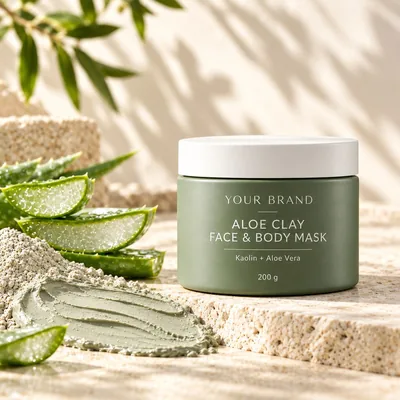
Mars’s Aloe Vera & Kaolin Face and Body Mask pairs kaolin with aloe for a gentler feel, and the Kaolin Clay Oil-Control Cleanser brings clay into a daily cleanser for customers who want the benefit without a weekly mask.
Clay mask for oily, dry and sensitive skin
Clay masks suit oily skin best, but well-built formulas can work for dry and sensitive skin too. The difference is in the clay choice and the supporting ingredients.
- Oily and acne-prone skin: kaolin or charcoal with salicylic acid; once or twice a week on the T-zone.
- Combination skin: multi-masking, with clay on the T-zone and a hydrating mask on the cheeks.
- Dry skin: a hydrating clay mask with glycerin, aloe or plant oils; short contact time.
- Sensitive skin: fragrance-free kaolin with soothing ingredients; rinse before it dries completely.
Detox clay mask and detoxifying clay mask are popular search phrases, but “detox” has no measurable meaning on skin. Safer copy talks about clarifying, purifying or absorbing excess oil.
Packaging follows the skin type, too. Tubes keep a clay mask fresher and are more hygienic for frequent use, while wide jars suit thick mud textures and multi-masking with a brush. Either way, a tight seal stops the paste from drying out between uses.
Salicylic acid: what does “strongest” mean?
The strongest salicylic acid allowed in cosmetics depends on the market, typically up to about 2% in face products, and higher is not automatically better.
Regulations set limits by product type and region, and some markets regulate salicylic acid for acne as an OTC drug with its own rules. In practice, the formula’s pH, the vehicle and how long it stays on the skin matter as much as the percentage. A 2% leave-on serum is far more intense than a rinse-off mask at the same level. Brands should check their market rules early; our article on AHA, BHA and PHA exfoliants explains the differences. Mars lists a Salicylic Acid Purifying Serum as a leave-on partner for a clay mask.
Will rosehip seed oil cause acne?
Rosehip seed oil is light, rich in linoleic acid and generally considered low on the comedogenic scale, so it rarely causes breakouts, though any oil can for some people.
It is popular as a rosehip oil for oily skin and for the look of blemish marks, because it absorbs quickly and feels dry rather than greasy. Whether rosehip seed oil helps acne itself is a different question: it supports a comfortable, balanced-feeling skin barrier, but it is not an anti-blemish active. Our rosehip oil and facial oils guide covers this in more depth.
Blemish patches: the companion to a clay mask
Blemish patches cover individual spots between mask days, protecting them from touching and helping them look calmer. They are the natural add-on product in a pore-care line.
Hydrocolloid patches absorb fluid from a surfaced spot and keep it covered; invisible versions are thin enough for daytime wear. Microneedle patches with dissolving hyaluronic acid cones suit early, under-the-surface spots. Mars lists a Hydrocolloid Blemish Patch, an Invisible Hydrocolloid Blemish Patch and a Hyaluronic Acid Microneedle Blemish Patch. Customized or personalized acne treatment plans belong with a dermatologist; patches and masks are supportive cosmetic steps.
Launching your own clay mask line with Mars
Mars helps brands launch clay masks, pore masks, clarifying cleansers and blemish patches under their own label, starting from catalogue formulas.
- Choose formulas from the masks and patches range and facial cleansers, or brief a new clay blend through ODM development.
- Test samples first, then approve a digital proof of tube, jar or patch-box artwork, with label languages for your markets.
- Receive documents: products are made to cosmetic GMP (ISO 22716 / GMPC), with stability checks, batch records, MSDS and COA per batch on request, and a full INCI list to support registration.
To compare textures and clays, request clay mask samples.
Mars product team
Product specialists at Shanghai Mars Cosmetics Co., Ltd., Shanghai. Questions about this article? Contact us.