Ingredients
Natural skin care claims explained: natural, organic, clean, vegan and “free-from” for brand owners
Natural skin care claims explained: what natural, organic, clean, non-toxic, vegan, cruelty-free and free-from mean, and how to substantiate them honestly.

Natural skin care means products made mainly from plant, mineral or other naturally derived ingredients. Unlike “SPF” or “organic” in many markets, “natural” has no single legal definition, which is why the word appears on everything from pure plant oils to conventional creams with one botanical extract.
For brand owners, the opportunity is real: shoppers actively search for natural beauty products, organic skin care and clean beauty. The risk is also real: vague or misleading claims can breach advertising rules and lose customer trust. This guide explains what each common claim means, what it doesn’t mean and how to support it.
What is natural skin care?
Natural skin care is skin care formulated predominantly with naturally derived ingredients, defined by the brand and ideally backed by a calculated natural-origin percentage. Without a definition, the word tells customers very little.
Most natural skincare products still contain some processed or synthetic ingredients, because they are needed for safety and performance:
- Preservatives keep water-based creams and lotions free from microbial growth.
- Emulsifiers hold oil and water together in a stable cream.
- Naturally derived ingredients, such as glycerin or plant-based surfactants, are processed from natural sources.
The international standard ISO 16128 gives a method for calculating natural and natural-origin content. Quoting an index calculated this way is far more credible than “made with natural ingredients”.
What do natural, organic, clean and free-from claims mean?
Each claim on a natural or organic skincare product describes something different, and each needs different evidence. The table summarizes the most searched terms.
| Claim | What it means | What it doesn’t mean | How to support it |
|---|---|---|---|
| Natural | Mainly naturally derived ingredients, as defined by the brand | Safer, gentler or free from processing | Natural-origin index per ISO 16128, full INCI list |
| Organic | Ingredients grown and processed to an organic standard | Simply “plant-based” | Accredited third-party organic standard covering ingredients and production |
| Clean | Leaves out a brand-chosen list of ingredients | A legal or scientific category | Published definition and exclusion list |
| Non-toxic | Intended as “safe for use” | That other products are toxic | Safety assessment; better replaced with specific wording |
| Vegan | No animal-derived ingredients | No animal testing | Supplier declarations for every raw material |
| Cruelty-free | No animal testing of product or ingredients | Vegan | Supplier statements and a recognized cruelty-free standard |
| Paraben-free | No parabens in the formula | Preservative-free | Formula and preservative system review |
| Sulfate-free | No sulfate surfactants | Automatically mild | Formula review |
What makes organic skin care different?
Organic skin care is the one category where the word usually has formal rules: in many markets, an organic claim requires ingredients and processing that meet an accredited organic standard, checked by an independent body.
That has practical consequences for brands:
- Organic raw materials must be traceable through the supply chain.
- The production site and process are inspected against the chosen standard.
- Labels follow the standard’s rules on percentages and logo use.
Mars does not hold organic accreditation, so Mars products are not described or sold as organic. Brands that want an organic seal should choose a supplier accredited to their target standard. What Mars can offer is a plant-based skin care positioning built on recognizable botanical ingredients, described honestly.
Clean beauty and non-toxic skin care: what are the rules?
Clean beauty and non-toxic skin care are marketing terms, not regulated categories. The rules that apply are the general ones on truthful, substantiated advertising.
In the EU, cosmetic claims must meet common criteria including legal compliance, truthfulness, evidential support, honesty, fairness and informed decision-making. In the US, the FTC expects claims to be truthful and backed by evidence. Two practical consequences follow:
- Don’t denigrate permitted ingredients. Saying or implying that ingredients allowed by law are harmful is restricted in several markets.
- Avoid “non-toxic” as a headline. “Fragrance-free”, “formulated without parabens” or “suitable for sensitive skin” are clearer and easier to support.
Free-from claims such as paraben-free or sulfate-free are acceptable when true and useful to the customer, for example for people who choose to avoid a specific ingredient.
Vegan and cruelty-free: two separate claims
Vegan refers to ingredients; cruelty-free refers to testing. Organic and vegan cosmetics are popular together, but each claim must be checked separately.
- Vegan: every raw material must be free from animal-derived materials. In the Mars catalogue, products featuring collagen, bird’s nest, salmon-derived PDRN or milk exosome are clearly not vegan, while many plant-based formulas may qualify after a raw-material review.
- Cruelty-free: the EU has banned animal testing of cosmetics and their ingredients since 2009, and the sale of newly animal-tested cosmetics since 2013. Rules differ elsewhere, so brands should confirm requirements for each market and the cruelty-free standard they reference.
Which natural skin care ingredients work well in formulas?
Plant oils, butters and botanical extracts are the backbone of skin care using natural ingredients, each with a clear cosmetic role. These examples appear in Mars catalogue formulas:
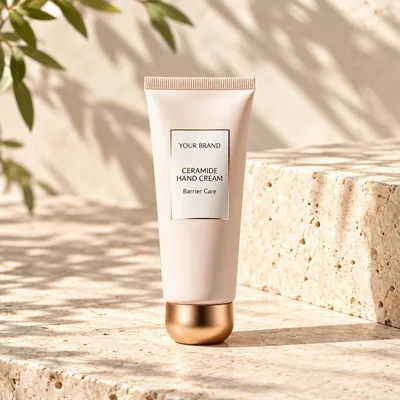
- Shea butter: rich emollient for very dry skin, as in the Shea & Ceramide Body Butter.
- Colloidal oatmeal: soothes and comforts dry skin, as in the Oat Nourishing Body Cream.
- Jojoba oil: a light, skin-like oil for face and body, as in the Jojoba Face and Body Oil.
- Centella asiatica: calms the look of redness and supports the skin barrier, as in the Calming Centella Cream.
- Coconut water and oil: hydration and softness, as in the Hydrating Coconut Cream.
Featuring a plant hero ingredient is different from claiming the whole product is natural. Name the hero ingredient, and keep the “natural” claim for formulas where the natural-origin index supports it.
How to write natural skin care claims step by step
Honest natural claims start from the formula and the evidence, then move to the wording. This order keeps marketing and compliance aligned.
- Get the full INCI list for every product and check each claim against it.
- Define your terms on your website: what “natural” or “clean” means for your brand.
- Calculate before you claim: use ISO 16128 for any natural-origin percentage.
- Collect raw-material declarations for vegan, cruelty-free and allergen statements.
- Prefer specific wording such as “with shea butter and oat” over sweeping terms.
- Review claims per market, because the EU, UK, US and other markets apply their own rules.
Why natural products still need preservatives
Any product containing water needs a preservative system, because water allows bacteria, yeast and mold to grow. “Preservative-free” is only realistic for anhydrous products such as oils and balms, or for special single-use packaging.
Preservation is confirmed with a challenge test (ISO 11930), and the full formula goes through a safety assessment. Our guide to cosmetic compliance and safety testing explains these steps.
Launching a natural skin care line with Mars
Mars helps brands build plant-led ranges from its body care and face cream and lotion catalogues, with honest claim wording from the start.
- Choose formulas built around recognizable botanical hero ingredients.
- Review the full INCI list to decide which claims, such as paraben-free or fragrance-free, are accurate.
- Develop new formulas to your ingredient preferences as an ODM project.
- Samples before volume production, and a digital proof before printing.
- Documents: MSDS, COA per batch on request and the full INCI list, made to cosmetic GMP (ISO 22716 / GMPC).
Request samples of plant-based formulas to start planning your range.
Mars product team
Product specialists at Shanghai Mars Cosmetics Co., Ltd., Shanghai. Questions about this article? Contact us.